

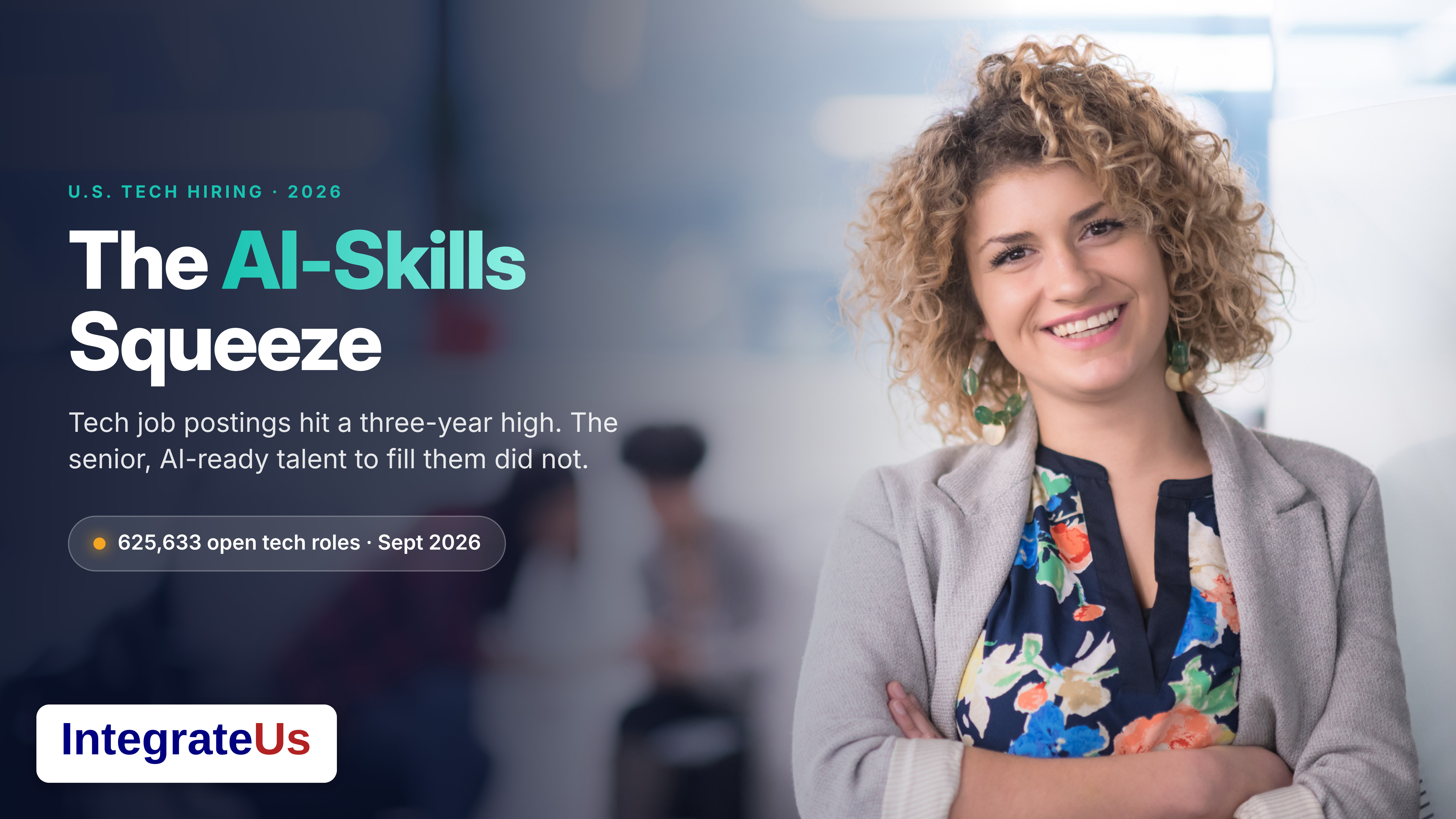
Consider a hiring paradox worth a closer look. In September 2026, U.S. employers had more than 625,000 active technology job postings open, the highest total in more than three years. In the same month, preliminary estimates show tech employment fell. If demand rises, why isn't hiring?
The short answer is that employers are not short of applicants. They are short of experienced technologists who can put AI to work inside real systems. In this article, IntegrateUs looks at what the latest data shows, why the gap is forming, what it costs, and which hiring models fit in which situations.
The background: from hiring freeze to selective rebound
After the 2022 to 2024 correction, many technology teams spent two years cutting, consolidating and pausing requisitions. That correction has not fully ended. Challenger, Gray & Christmas reports that technology companies announced 165,925 job cuts through September 2026, up 54% from the same period in 2025, and that technology accounts for 29% of all announced cuts this year (Challenger, Gray & Christmas, Oct. 1, 2026).
Yet demand is returning at the same time, in a different shape. Reopened roles now ask for more experience and more AI fluency than they did a few years ago.
What the latest U.S. data shows
Demand is at a three-year high
CompTIA's analysis of Lightcast job-posting data for September 2026 found (CompTIA, Oct. 2, 2026):
- 625,633 active tech job postings, the highest total in more than three years and up 22.4% year over year.
- 272,040 new tech postings in the month, up 16% from September 2025.
- 349,821 active postings requiring AI-related skills, up about 282% since May 2024.
- Software developers and engineers led new openings, with 47,598 new postings.
Employment has not kept pace
The same report estimates that tech sector employment declined by about 10,350 positions in September, and that employment in tech occupations across all industries fell by roughly 6,000. Tech unemployment edged up to 3.3%, still below the national rate of 4.2%. CompTIA notes that monthly occupation data is volatile and subject to revision, so a single month should be read as a signal, not a verdict.
The wider labor market is also cautious. The Bureau of Labor Statistics reported total nonfarm payrolls "changed little" in September (+29,000), with employment in computer systems design and related services down an estimated 4,400 for the month (preliminary, seasonally adjusted) (BLS Employment Situation, Oct. 2, 2026; Table B-1). Nationally, job openings held at 7.5 million while hires were 5.4 million (BLS JOLTS, Nov. 3, 2026).
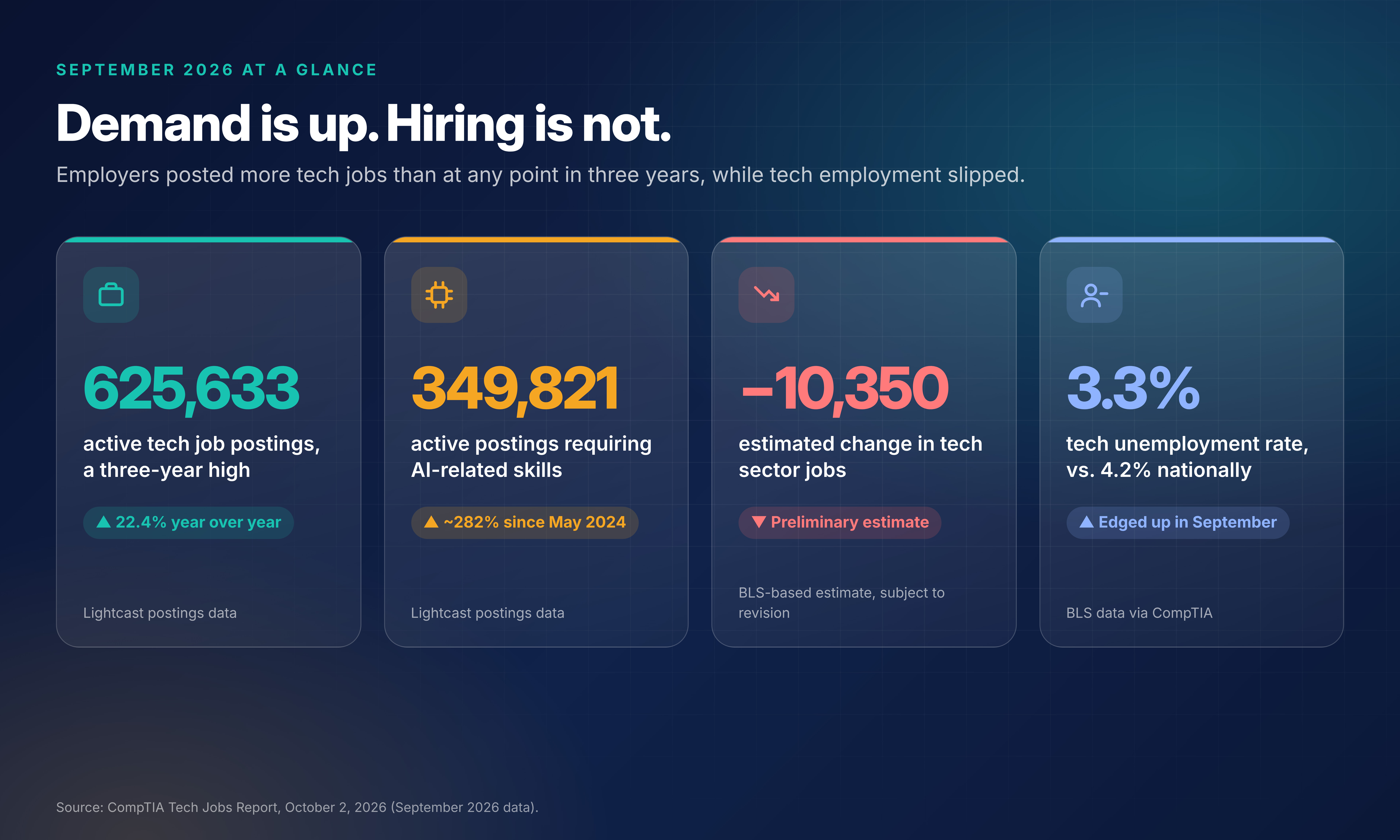
Source: CompTIA Tech Jobs Report, October 2, 2026.
Demand is concentrated in senior, AI-fluent roles
Indeed Hiring Lab's research shows where the rebound is landing. U.S. software development postings on Indeed grew almost 15% between late February 2025 and mid-2026, while overall postings fell 7%. Even so, software postings remain about 27.5% below pre-pandemic levels. Most tellingly, 71% of the increase in software development postings between May 2025 and May 2026 came from senior roles, and 37% came from jobs that mention AI in the title (the two groups overlap) (Indeed Hiring Lab, July 8, 2026).
A separate Hiring Lab analysis of salaried postings found that, in the most AI-exposed occupations (including software development, IT systems and support, and data and analytics), the entry-level share of postings fell from 29% to 10% between 2021 and 2026, while the senior share rose from 22% to 47%. Advertised pay in those occupations climbed about 46% since 2021, compared with 25% in the least-exposed occupations (Indeed Hiring Lab, Sept. 17, 2026).
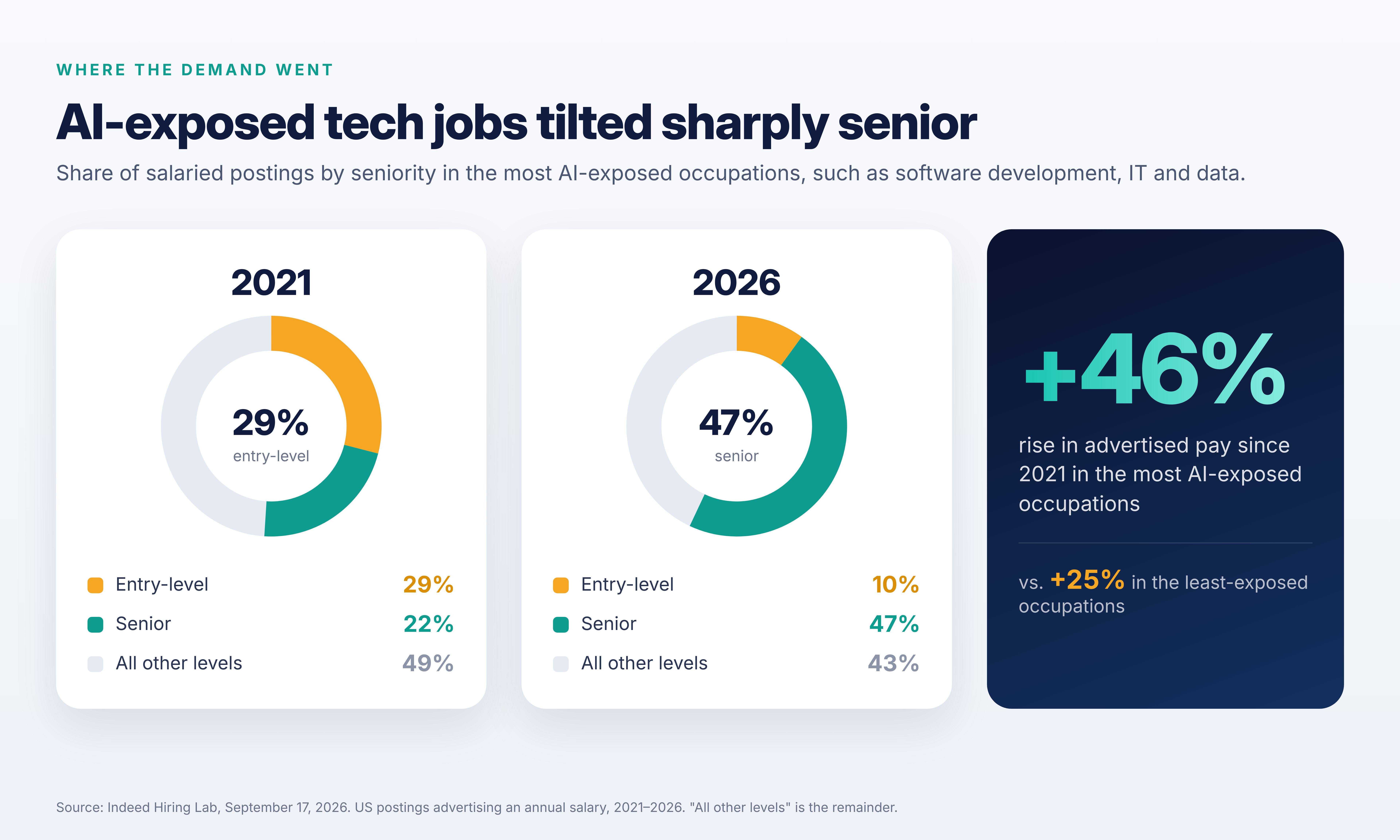
Source: Indeed Hiring Lab, September 17, 2026.
The employer pain points behind the numbers
Put those figures together, and a clear pattern emerges. Many employers are competing for the same relatively small pool of experienced people. The pain shows up differently depending on the seat:
- CIOs and CTOs have AI and modernization initiatives approved and funded, but those initiatives stall at staffing. A pilot with no one senior enough to take it to production is just a demo.
- Talent acquisition leaders see full applicant pipelines that still don't contain the right profile. Volume is not the problem. Fit is.
- Hiring managers are asked to find people who combine a core discipline, such as data engineering, cloud or security, with practical experience applying AI tools in that discipline. Few candidates have both.
- HR and finance leaders face rising pay expectations for AI-exposed roles.
- Public-sector IT leaders compete for the same scarce profiles with fixed pay scales and procurement timelines.
Root causes: why the gap is forming
- Requirements moved faster than the workforce. AI-related skills now appear in hundreds of thousands of postings. Experience applying those skills in production environments takes years to build.
- Teams cut junior hiring first. When entry-level postings shrink, so does the pipeline of people who would have become tomorrow's senior engineers. The squeeze compounds over time.
- Employers want proven experience to reduce risk. After a period of layoffs and tighter budgets, many organizations prefer hires who can contribute immediately, which concentrates demand at the top of the experience curve.
The business consequences of leaving roles open
An open requisition is not a neutral event. When a critical AI or data role stays vacant, the effects ripple:
- Delayed initiatives. Funded projects slip, and the business case erodes while the budget sits idle.
- Burnout on existing teams. Remaining engineers absorb the work, which raises turnover risk among exactly the people you can least afford to lose.
- Rising costs. Pay for AI-exposed roles is rising faster than for other occupations, so delayed hiring decisions can mean higher offers later.
- Security and governance risk. AI deployments without experienced oversight can create data handling and compliance exposure. The BLS projects employment of information security analysts to grow 21% from 2025 to 2035, much faster than the average for all occupations. That projection shows how much demand already exists for this kind of oversight (BLS Occupational Outlook Handbook).
Available solutions: choosing the right hiring model
No single model solves every gap. The right choice depends on how urgent the need is, how long it will last and whether the capability is core to your business.
Contract staff augmentation
- Best for: Urgent, time-boxed work such as a pilot, migration or deadline.
- Main advantage: Fast access to specialized skills without adding long-term headcount.
- Trade-off: Knowledge can leave when the contract ends unless you plan the transfer.
Contract-to-hire
- Best for: Likely permanent roles where fit is still uncertain.
- Main advantage: Real on-the-job performance data before you commit.
- Trade-off: Some candidates prefer direct offers.
Direct hire
- Best for: Core, long-term capabilities you must own.
- Main advantage: Retains institutional knowledge and builds culture.
- Trade-off: Longest time-to-fill and highest commitment.
Upskilling current staff
- Best for: Teams with strong domain knowledge but new AI requirements.
- Main advantage: Builds loyalty and keeps context in-house.
- Trade-off: Takes time and often needs senior guidance to succeed.
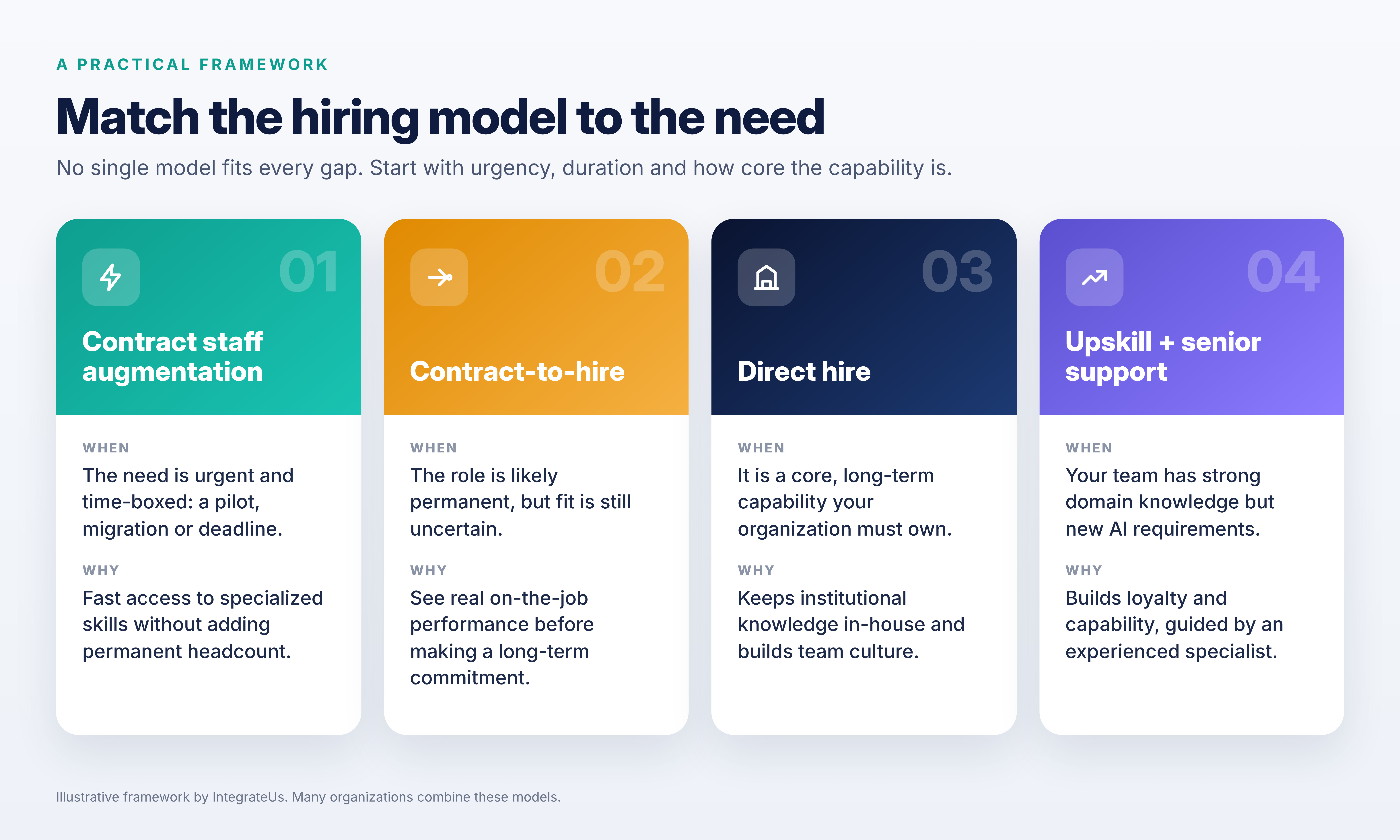
Many organizations blend these models. For example, an experienced contractor stands up the capability alongside internal staff, and the role is converted or hired permanently once proven.

Practical recommendations for U.S. employers
- Separate must-have from nice-to-have. Rewrite AI job descriptions around the two or three outcomes the role must deliver in its first six months.
- Hire for applied experience, not tool lists. Ask candidates to walk through an AI or automation project they shipped, including what failed.
- Use skills-based technical screens. Short, practical assessments reveal more than keyword matches on a résumé.
- Protect a junior pipeline. Even a small apprenticeship or associate program, paired with senior mentors, reduces future dependence on a scarce market.
- Benchmark pay against current data. Salary bands set two years ago may not reflect today's market for AI-exposed roles.
- Match the hiring model to the need. Use contract talent for urgent, defined work and reserve direct-hire budget for capabilities you must own.
- Plan knowledge transfer from day one. Make documentation and pairing part of every contract engagement.
How IntegrateUs can help
IntegrateUs is an AI-enabled staffing company founded in Austin, Texas, in 2011. Its recruiters use AI tools to find, match and screen talent, and pair them with human judgment on fit. IntegrateUs places contract, contract-to-hire and direct-hire talent across the United States, which lets employers choose the model that matches the need rather than forcing one approach.
For organizations facing the AI-skills squeeze, IntegrateUs can support:
- IT staff augmentation for contract technologists who plug into your team, tools and delivery cadence, including role intake, a shortlist with technical screen notes, interview coordination and onboarding.
- Direct hire and recruiting for permanent roles you need to own long term.
- Specialized talent in data and analytics, cloud and infrastructure and cybersecurity.
- Texas public-sector agencies that need experienced IT talent for modernization and AI initiatives.
Staffing is not the answer to every gap. If your team already has strong domain experts, a structured upskilling program may deliver more value, and a good staffing partner should tell you so.
Talk to a recruiter about your hardest AI role
If an AI, data or cloud initiative is waiting on the right person, send IntegrateUs the role description, a statement of work or even a rough idea. Start a conversation with IntegrateUs to discuss which hiring model fits your timeline and budget.
Conclusion
The September 2026 data tells a nuanced story. Demand for technology talent is the strongest it has been in three years, but it is concentrated in senior, AI-fluent roles that the market cannot easily supply. Employers who sharpen their requirements, screen for applied experience, protect their junior pipeline and use flexible hiring models deliberately will close critical roles faster than those who wait for the market to loosen.