

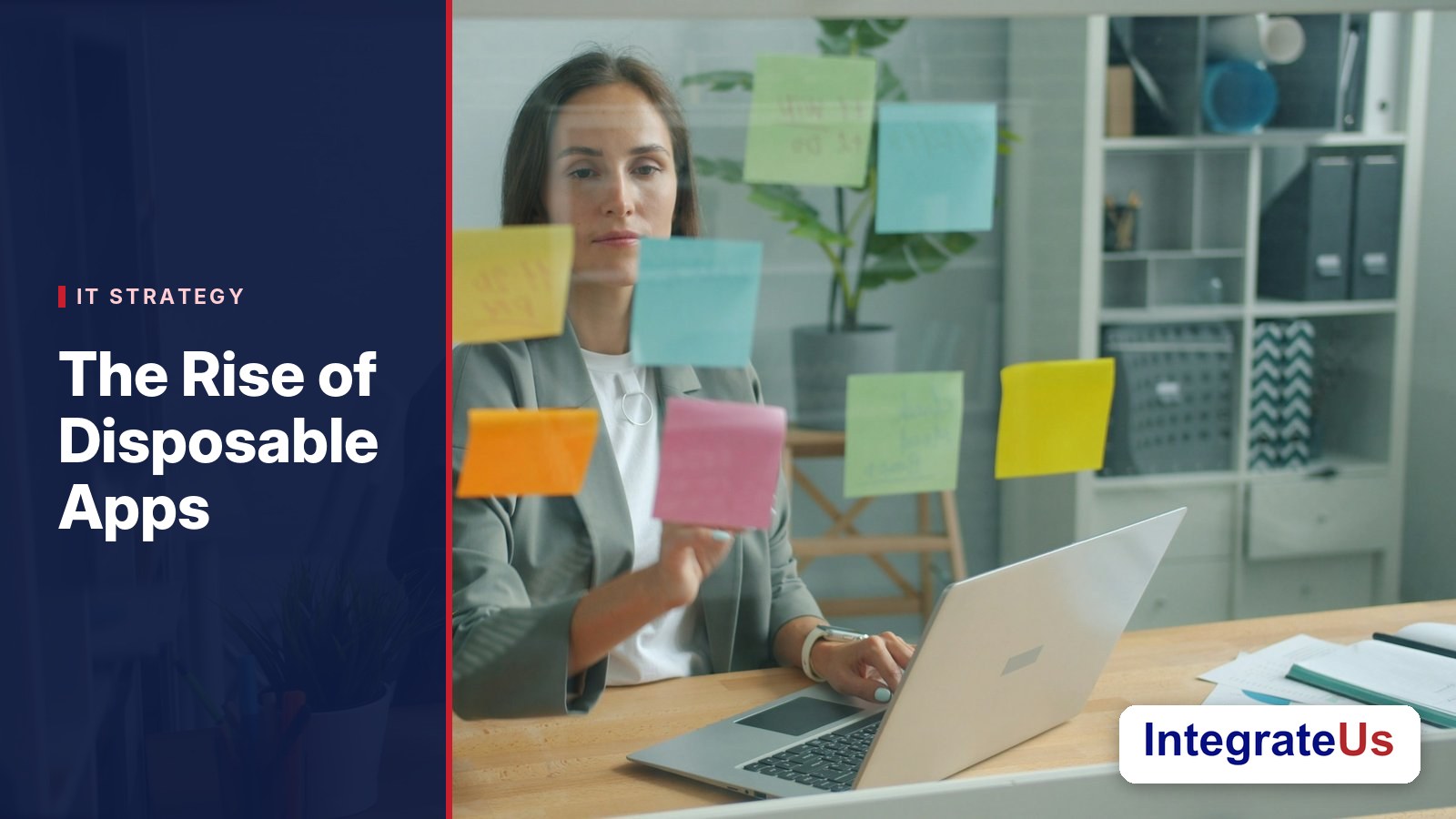
Someone on your team needs a tool to track vendor renewals. They describe it to an AI assistant, and by lunch it works. When renewal season ends, they delete it.
Gartner calls these disposable applications: software designed to be retired once its job is done. It has named them one of its top strategic technology trends for 2027, and it announced the full top 10 list on October 20 at Gartner IT Symposium/Xpo in Orlando.
IntegrateUs places IT talent with businesses and Texas public agencies, so we watch closely how trends like this change the skills teams need. Here is what disposable applications mean for your IT team.
By 2029, most new apps won't be built to last
Gartner predicts that by 2029, 80% of new applications will be intentionally disposable, used for less than a year. Because AI makes building software accessible, employees will increasingly create temporary apps for short-term business needs.
Gene Alvarez, a Distinguished VP Analyst at Gartner, said the shift "fundamentally alters how software is bought, designed and budgeted for." Gartner also cautions that trying to lock down AI development to control app sprawl is a losing battle that holds back innovation. Instead, it advises CIOs to adopt a disposable application strategy that keeps governance and control of the application portfolio.
What changes for IT teams

Guardrails, not gates. Give people one approved place to build, clear rules on which data their apps can touch, and an end date on every app.
Security at the same speed. An app built in a day can still handle real customer and company data. Reviews have to keep pace, or they get skipped.
Different skills on the team. As more apps become disposable, IT teams will likely spend less time on long-lived code and more on platform engineering, data governance, security and helping colleagues build safely.
What can go wrong. Picture a program manager who uses an AI tool to build a quick dashboard of vendor pricing and contact details from a shared drive. It works, so she shares the link with an outside consultant. Now anyone with that link can see company data. IT does not know the app exists, and no one owns or has documented it. When the project ends in March, the app keeps running, still connected to the data. In a public agency, that data could just as easily be information about residents.
Four basic controls reduce these risks:
- Access controls limit who can open each app and which data it can reach.
- An application inventory shows IT every app in use.
- A named owner and a one-page description make someone accountable for each app.
- A retirement date switches off the app and its data access when the job is done.
How IntegrateUs helps
Start small: pick one team that is already building with AI, set its guardrails this quarter, then copy what works. Each of those controls needs skilled people to set up and run. As an IT staffing partner, IntegrateUs finds and places the professionals who do that work:
- Cloud and infrastructure engineers build and run the approved platform where employees create apps, with access controls, logging and automatic shutdown at each app's end date.
- Cybersecurity specialists review apps before they reach sensitive data, manage who has access, and find exposed or forgotten apps.
- Data and analytics professionals classify sensitive data, set rules on which data apps may use, and track which apps use it.
We can place them on contract, contract-to-hire or direct hire.
Planning your AI and IT staffing for 2027? Talk to IntegrateUs about the cloud, security and data talent your team needs.
Sources
- Gartner, Top Strategic Technology Trends for 2027: Disposable Applications, October 16, 2026
- Gartner, Gartner Identifies the Top Strategic Technology Trends for 2027, October 20, 2026
- Gartner, Top Strategic Predictions for 2027 and Beyond, September 15, 2026